
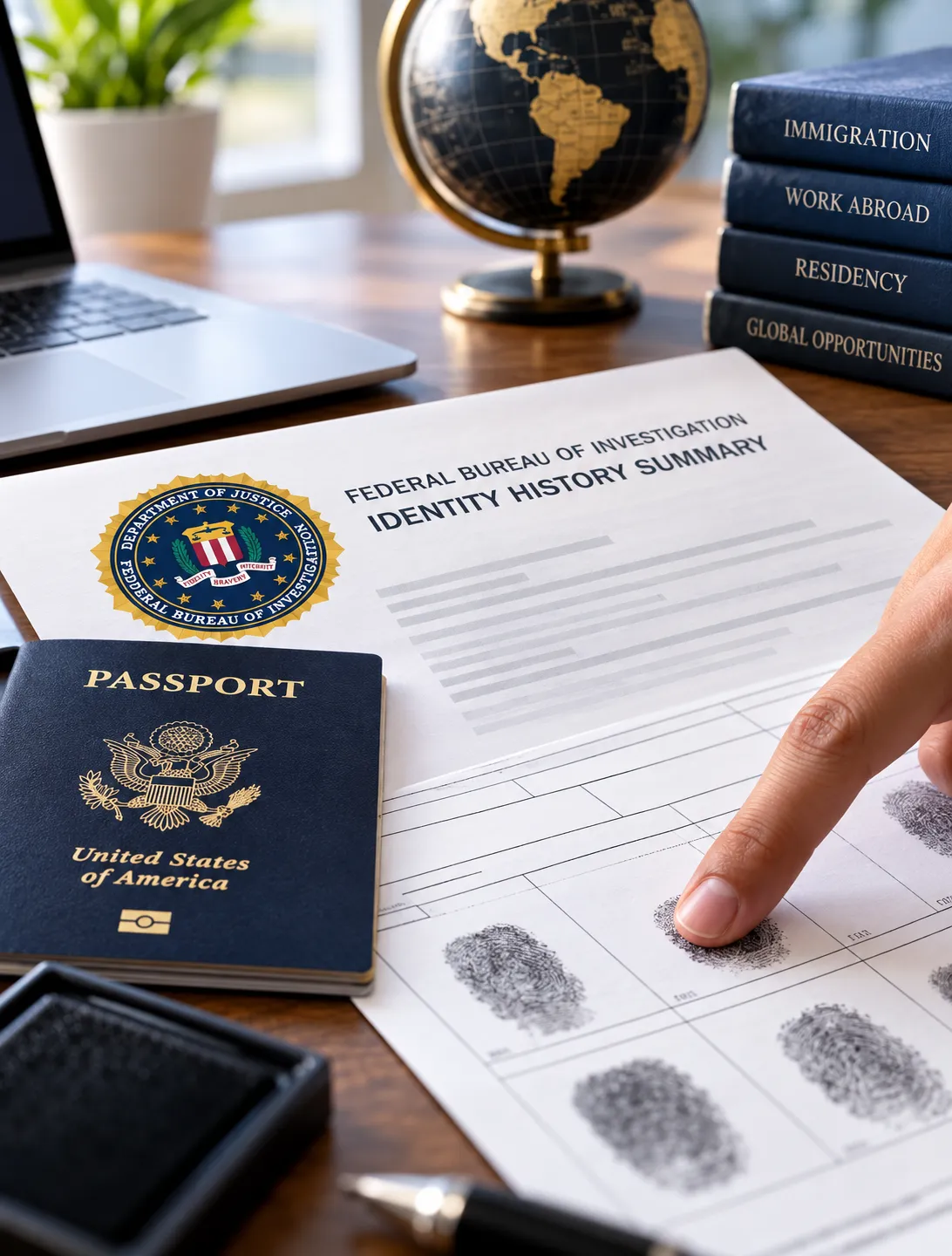
An FBI background check is an official record of the criminal history information the FBI holds against your fingerprints. The FBI calls it an Identity History Summary. Foreign immigration, employment and residency authorities commonly ask for it when you have lived or worked in the United States.
You can request your own summary from the FBI for an official fee of $18, but the process involves more than completing a form. The FBI matches your record to your fingerprints, so a clear, correctly captured set is essential. If you live outside the United States, getting those prints taken and submitted takes extra planning. Many destination countries also want the document apostilled.
This guide explains what an FBI background check contains, who needs one, how to apply, how long it can take and how apostille requirements work. It also covers applying from overseas, the mistakes that delay applications and how Global Visa Management Group (GVM Group) can support you.
What Is an FBI Background Check?
An FBI background check, officially an FBI Identity History Summary, is a record of the identity history information the FBI holds that matches your fingerprints. People often call it a “rap sheet”. You can request a copy of your own summary, and receiving authorities may ask for it as proof of your criminal history in the United States.
The FBI describes the summary as information taken from fingerprint submissions linked to arrests, federal employment, naturalisation or military service. If the FBI holds no matching record, the response says so. That result is what many authorities want to see.
FBI Check vs State-Level Criminal History Check
A state-level check draws on records held by one state’s repository. An FBI criminal background check draws on fingerprint records submitted to the national database, so it can reflect activity recorded in more than one state. For that reason, foreign authorities usually ask for the FBI version. Always confirm which one the requesting authority names before you apply, because ordering the wrong type costs time and money.
Why Authorities Request One
Government departments, employers and licensing bodies want independent confirmation of your criminal history. Fingerprint-based records are harder to dispute than a self-declaration, which is why they appear so often in immigration and regulated-work applications.
Who Needs an FBI Background Check?
You may need an FBI background check if you are a US citizen, a former US resident or anyone who has lived or worked in the United States and now applies for something overseas. Requirements vary by destination country and application category, so the requesting authority always has the final say.
Immigration and Visa Applications
Many countries ask for a police certificate from each country where you have lived for a set period, often six or twelve months within a recent window. For time spent in the United States, the FBI Identity History Summary is usually the federal-level document. Check the visa instructions for the exact certificate and age limit. Our team also assists with international visa applications if you need wider support.
International Employment
Schools, employers and regulators abroad may require criminal history documentation before they confirm a job offer or licence. Teachers and other regulated professionals meet this requirement most often.
Residency and Citizenship Applications
Permanent residency and naturalisation processes often include a criminal history check covering every country you have lived in. If the United States is one of them, expect to supply an FBI background check.
How to Apply for an FBI Background Check
You apply by submitting the FBI’s request, your fingerprints and the $18 fee. You can do this online through the FBI’s Electronic Departmental Order (eDO) portal, through an FBI-approved channeler or by mailing a fingerprint card to the FBI. Your choice affects speed, cost and how you receive your results.
| Route | How it works | Fees | Speed |
| FBI eDO portal | Submit your request and pay online at edo.cjis.gov | $18 FBI fee, plus fingerprinting | Varies with fingerprint route |
| FBI-approved channeler | Fingerprints are submitted electronically through an approved company | $18 FBI fee plus the channeler’s own fee | Generally faster than mail |
| Mail to the FBI | Send a signed request form, fingerprint card and payment to FBI CJIS Division, Clarksburg, West Virginia | $18, plus fingerprinting and postage | Generally the slowest route |
Step 1: Determine Your Application Requirements
Confirm what the requesting authority wants. Ask whether it needs an FBI Identity History Summary rather than a state check, whether it requires an apostille and how recent the document must be. Get the answer in writing if you can.
Step 2: Complete the Application
The FBI’s official channels ask for personal details such as your full name, date of birth and place of birth. Enter them exactly as they appear on your identity documents. A mismatch can delay or derail the request.
Step 3: Submit Fingerprints
The FBI needs a full set of your fingerprints. These are usually captured on a standard FD-258 fingerprint card using ink, or electronically through an approved provider. A trained operator should take the prints, because smudged or partial impressions can lead to a rejected request.
Step 4: Pay the Application Fee
The FBI charges an official processing fee of $18 per request. Fingerprinting, courier costs, channeler fees and any assistance service cost extra. The FBI does not accept cash or personal cheques, so use the payment methods it lists.
Step 5: Receive Your FBI Background Check
Your results arrive electronically where your route allows it, or by post. Check the receiving authority’s rules on electronic copies before you rely on a PDF.
How to Get an FBI Background Check From Outside the USA
You can apply for an FBI background check while living abroad. The main challenge is fingerprints: you must have them captured correctly in your country of residence and then get them into the FBI’s system. Planning for this step, and for delivery, prevents most delays.
A typical overseas process looks like this:
- Find a suitable local provider that can capture clear fingerprints on the correct card or format.
- Submit the request and fingerprints to the FBI, either by post or through an approved channeler.
- Arrange delivery to your overseas address, or request an electronic copy where available.
- Add time for apostille or authentication if your destination requires it.
International applicants often run into the same complications. Local police stations may not offer fingerprinting for this purpose. Courier times add up, and a rejected card means starting again from scratch. Some destination countries also want the document authenticated before they accept it.
GVM Group assists clients living in South Africa and elsewhere with this process, including FBI background check services with fingerprinting at our Sandton, Pretoria and Cape Town offices.
FBI Background Check Apostille and Authentication Requirements
An apostille is a certificate that confirms a public document is genuine so that another country will accept it. The US Department of State’s Office of Authentications issues apostilles for federal documents, including FBI background checks. Whether you need one depends on the country that will receive your document.
Countries that belong to the Hague Apostille Convention generally accept an apostille. Countries outside the Convention may instead require an authentication certificate, sometimes followed by legalisation at their embassy or consulate. The State Department lists its requirements and fee, currently $20 per document, on its authentication services page. Submissions use Form DS-4194, and you must name the country where you will use the document.
Confirm these points before you submit anything:
- Whether the destination authority requires an apostille at all.
- Whether it accepts an electronic copy or needs the original signed document.
- How recently the FBI check must have been issued.
Ordering the apostille before checking these details is a common and avoidable mistake. For South African documents, we also offer apostille and document authentication support.
Common Mistakes to Avoid When Applying for an FBI Background Check
Most delays come from a short list of preventable errors:
- Poor-quality fingerprints. Smudged, faint or incomplete prints are the leading cause of returned submissions.
- Incorrect personal information. Names or dates that differ from your identity documents can stall the request.
- Choosing the wrong type of check. A state check will not satisfy an authority that wants the FBI summary.
- Ignoring international delivery. Courier and postal times can add weeks.
- Overlooking apostille or authentication. Discovering the requirement after your results arrive forces a second round of processing.
- Timing. Applying too early can make the document too old, and applying too late can miss your deadline.
How Global Visa Management Group Can Assist
GVM Group helps international applicants work through documentation requirements. For FBI background checks, our support includes:
- Guidance on application requirements and the document your destination needs.
- Help with fingerprint submission procedures, including in-person fingerprinting at our Sandton, Pretoria and Cape Town offices.
- Support with international documentation requirements.
- Guidance on apostille and authentication.
We do not issue FBI reports and we do not control FBI processing times. The FBI alone decides your result and how long it takes. What we can do is help you submit a complete, accurate application and understand what happens next. You can also read about our police clearance certificate services if you need a South African certificate alongside your FBI check.
Need an FBI Background Check for International Use? Global Visa Management Group can help you understand the application process and available support options. Contact our team to discuss your requirements.
Unsure whether your FBI background check requires an apostille? Speak to our team about the document requirements for your destination country. Contact Global Visa Management Group.
